
Gor Mahia FC – History, Honours & Club Profile in Kenya
K’Ogalo – Kenya’s Most Decorated Football Club
21 Kenyan Premier League titles. Africa’s Cup Winners’ Cup 1987. 43 trophies. The only Kenyan club to win a continental title.
Gor Mahia Football Club is not merely Kenya’s most successful football club – it is the country’s most powerful sporting institution and one of East Africa’s defining cultural symbols. Based in Nairobi since its formal establishment on 17 February 1968, the club known as K’Ogalo has accumulated 21 Kenyan Premier League titles, 11 FKF President’s Cup victories, and the singular continental distinction of winning the 1987 African Cup Winners’ Cup – the only time any Kenyan club has lifted a CAF continental trophy. With 43 trophies across all competitions and a fanbase that transcends ethnic and regional boundaries to claim a national following, Gor Mahia FC stands apart from every other club in Kenyan football history.
Club History
Roots in Luo Community Football: The 1920s to 1968
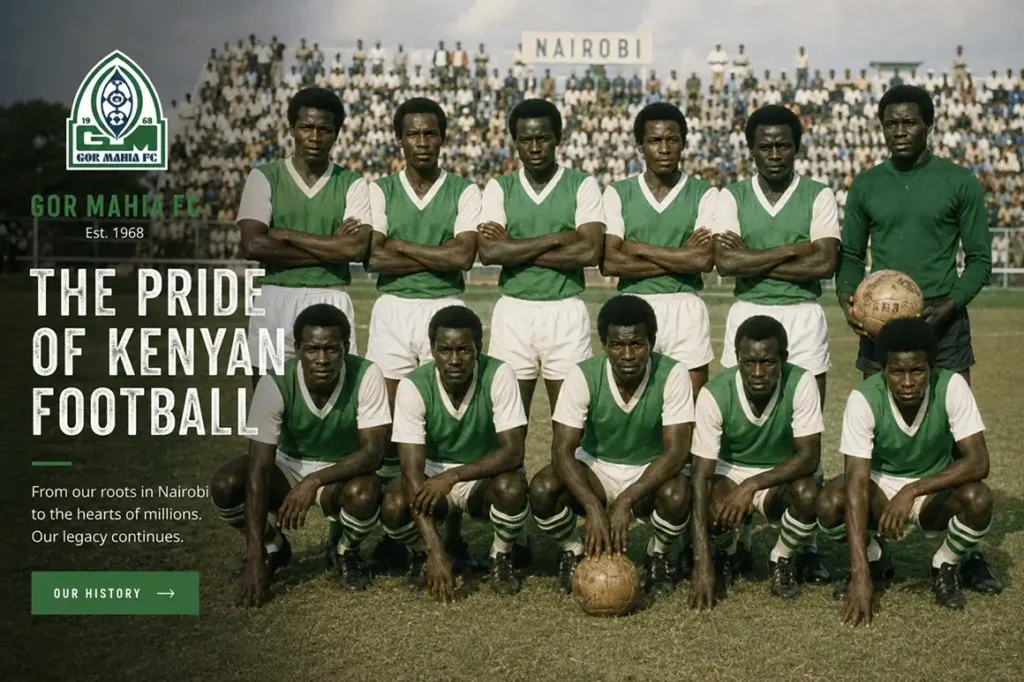
Gor Mahia’s origins reach back nearly a century before the club’s formal foundation, to the 1920s when the Luo Union was established as a welfare association to unite the Luo ethnic group across Kenya and the wider East African region. The association initially focused on social support, employment, and community cohesion for Luo migrants working in Nairobi and other Kenyan cities, but it later turned to football as a vehicle for community pride and solidarity, forming Luo Union FC as its sporting arm. This football wing played an increasingly important role in Nairobi’s football scene across the 1930s, 1940s, and 1950s, competing in regional competitions and building a grassroots following among the Luo diaspora in the capital. The social and political currents of post-independence Kenya in the 1960s, however, would reshape the club’s identity dramatically.
Following the political tensions of the mid-1960s – linked in part to the prominent Luo politicians Jaramogi Oginga Odinga and Tom Mboya, both towering figures in Kenya’s independence movement – the Luo Union experienced internal divisions that split its football operations. Luo Union FC eventually merged with its counterpart, Luo Sports Club (also known as Luo Stars), in 1968 to create a unified new institution. Several prominent and highly intellectual figures from the Luo community were involved in the founding gathering, including Tom Mboya, Samuel Ayany, Professor Bethwell Allan Ogot, and Zack Ramogo – the first chairman. The name chosen for the new club drew on Luo mythology: Gor Mahia was a legendary medicine man from Kanyamwa, Ndhiwa, in Homa Bay County, whose nickname – meaning “magic” in the Dholuo language – derived from his famous powers of mystical healing and spiritual transformation. The club’s nickname, K’Ogalo, comes from Gor Mahia’s full name, Gor Wuod Ogada Nyakwar Ogalo, meaning “descendant of Ogalo” in Dholuo. No name could have been more appropriate for a club that would go on to perform feats described by rivals and journalists as beyond ordinary explanation.
Immediate Champions and the Golden 1970s
The first competitive season of Gor Mahia’s existence – 1968 – produced an immediate and dramatic statement of intent. Playing as a newly unified club in the Kenyan National Football League, the Albiverdes won the national league title at the first time of asking, with legendary Kenyan striker William Ouma “Chege” scoring 19 goals across the campaign to drive the team to the championship. This was not the triumph of an experienced, established side but of a new institution finding its identity and winning immediately – an achievement that set the tone for everything that would follow. The second league title arrived in 1974, and in 1976 Gor Mahia achieved something that no Kenyan club had managed before: they won the National League campaign entirely unbeaten. The 1976 unbeaten title run was driven by playmaker Allan Thigo – who also served as a player-coach – alongside stars including Festus Nyakota, James Ogolla, Maurice Ochieng, and Jerry Imbo, recruited from Black Mamba. The title was clinched without a single league defeat, a record that stood for decades and confirmed that Gor Mahia’s early success had been no flash in the pan.
The late 1970s and early 1980s saw Gor Mahia establish absolute domestic dominance, winning league titles in 1979, 1983, 1984, 1985, and 1987 as well as multiple editions of the Kenya Challenge Cup. Continental ambitions were growing too: in 1979, Gor Mahia reached the final of the African Cup Winners’ Cup for the first time, an extraordinary achievement for East African football at that period. The final against Canon Yaoundé of Cameroon – one of the continent’s elite clubs of that era – was lost heavily on aggregate, with Gor Mahia suffering a 0–2 defeat at home and a 0–6 reversal in Yaoundé for an aggregate of 0–8. But the experience of that continental final, and the lessons learned from it, would prove formative for what was coming next.
1987: The African Cup Winners’ Cup and Continental History
The defining moment in Gor Mahia’s history – and in the history of Kenyan football – arrived on 5 December 1987 at the Kasarani Stadium in Nairobi. Having again qualified for the African Cup Winners’ Cup as Kenyan domestic cup holders, the Albiverdes navigated the continental draw with growing confidence. In the second round, they dispatched Costa Do Sol of Mozambique 2–1 at home and held them 0–0 away to advance. In the quarter-finals, they overcame LPRC Oilers of Liberia – drawing 0–0 in Nairobi in a famously difficult first leg, before winning 3–1 in Monrovia to advance. In the semi-finals, Gor Mahia beat El Merreikh of Sudan 1–0 in the first leg but lost 0–2 in Omdurman, a result that appeared to eliminate them until a late twist secured progression on away goals or aggregate depending on competition rules at the time.
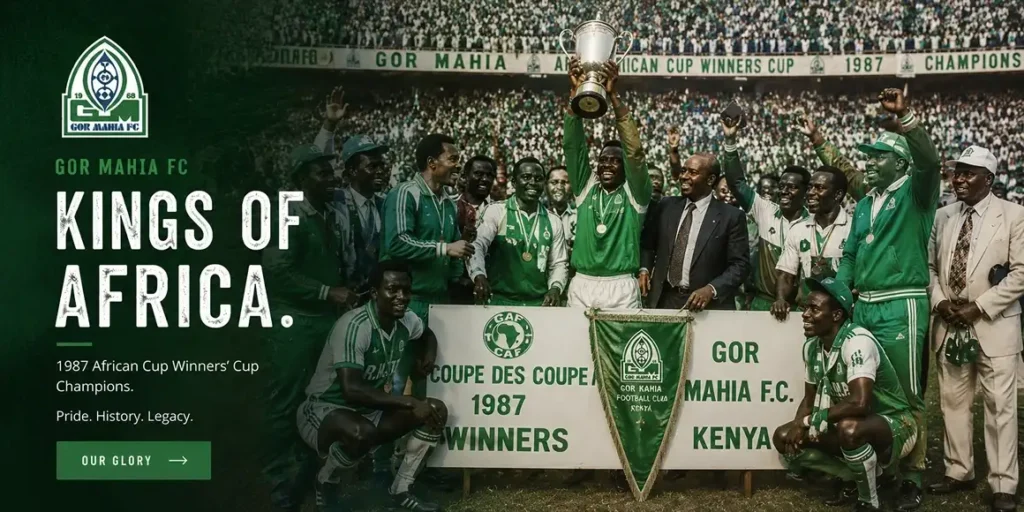
In the final, the opponents were Espérance de Tunis of Tunisia – one of North Africa’s most established clubs. The match was played on home soil in Nairobi’s Kasarani Stadium, which had itself been completed in 1987 for the All-Africa Games, and the combination of home advantage, a packed partisan crowd, and the tactical sophistication that coach Mohammed Kheri had instilled proved decisive. Gor Mahia won the trophy, becoming the first Kenyan club – and the only East African club to that date – to win a CAF continental title. The trophy is formally known as the African Cup Winners’ Cup, or the Mandela Cup. The victory sent shockwaves through African football and remains the single greatest achievement in the history of Kenyan club football. As defending champions in 1988, Gor Mahia opted to re-enter the Cup Winners’ Cup rather than contest the Champions League but exited early, with the focus returning to domestic consolidation.
Drought, Revival, and Modern Dominance: 1988–2024
The decade following the 1987 triumph brought a degree of domestic continuity – titles in 1990, 1991, 1993, and 1995 reinforced Gor Mahia’s status as Kenya’s leading club – before a prolonged trophy drought struck. The 1996 season was described within the club as the most disastrous in its history: eliminated in the first round of the CAF Champions League by Zimbabwean club Dynamos, the result provoked one of the most damaging crowd disturbances in Nairobi’s football history. After the 1995 league triumph, an 18-year drought in the domestic championship followed – a period of financial difficulties, administrative turbulence, and competitive struggles that tested the loyalty of even the most committed K’Ogalo supporters. The club returned to silverware in 2008 by winning the KFF Cup, and in 2009 captured the Kenya Super Cup. Then, in 2013, under Scottish coach Bobby Williamson and with goalkeeper Jerim Onyango playing a key role, Gor Mahia reclaimed the Kenyan Premier League title for the first time since 1995, ending one of the longest championship droughts in the club’s history. Back-to-back titles followed in 2014 and 2015, then again in 2017, 2018, and 2019 as Gor Mahia re-established themselves as the dominant force in Kenyan football. The most recent league title, the 21st in the club’s history, was secured in the 2023–24 FKF Premier League season, confirming that Gor Mahia’s grip on Kenyan football remains as firm as ever.
What Makes Gor Mahia FC Stand Out
Gor Mahia’s position in Kenyan football is without parallel. No other club in the country has won as many league titles, lifted a continental trophy, or built a supporter base of comparable size and passion. The 21 Kenyan Premier League championships represent a domestic dominance that is the envy of every rival in the country – the next most successful club trails substantially in the title count. The 1987 African Cup Winners’ Cup, won on home soil at Kasarani, gave Kenya its only continental football triumph and remains a source of national pride that transcends club allegiance. When K’Ogalo plays a CAF Champions League or CAF Confederation Cup tie, the whole country pays attention, because no other Kenyan club has come close to matching what Gor Mahia achieved on the African stage. The club’s 43 total trophies across all competitions – league titles, domestic cups, CECAFA Club Championship wins, Super Cups, and the continent’s top honour – represent a trophy cabinet unmatched in East African club football history.
The Mashemeji Derby – the encounter between Gor Mahia and their most bitter rivals AFC Leopards – is the most anticipated fixture in the Kenyan football calendar and one of the great derbies in African football. The rivalry stretches back to the formation of both clubs in the 1960s and is charged with ethnic, cultural, and civic dimensions: Gor Mahia are rooted in the Luo community while AFC Leopards draw their core following from the Luhya community, though both clubs have long since attracted nationwide support that extends far beyond any single ethnic group. The Mashemeji Derby generates scenes of extraordinary passion – packed stadiums, elaborate choreographed displays from both sets of supporters, incidents of dramatic individual brilliance, and the kind of winner-takes-all intensity that defines what rivalry means in football. Nairobi turns a particularly vivid shade of green-and-white or blue-and-black in the days before the fixture, with public debate, street commentary, and social media activity creating a city-wide atmosphere of anticipation.
The club also holds a unique place in Kenya’s political and cultural history. Founded by intellectuals and politicians including Tom Mboya – one of the architects of Kenyan independence and a figure of continental significance – the club has always been more than a sporting institution. In the 1970s, when Kenyan President Daniel arap Moi issued an order requiring clubs to drop names directly linked to ethnic identities, Gor Mahia survived by retaining its name while the Luo Union welfare organisation was disbanded. This act of institutional survival in a politically charged environment reinforced the club’s identity as something that could not simply be dissolved or renamed by government decree. The club is known as “Sirkal” – the Dholuo word for “government” – not as a political statement but as an acknowledgement of the power and authority the institution commands among its followers.
Honours and Achievements
FKF Premier League / Kenyan Premier League – 21 titles:
- 1968, 1974, 1976, 1979, 1983, 1984, 1985, 1987, 1990, 1991, 1993, 1995, 2013, 2014, 2015, 2017, 2018, 2019, 2021, 2022, 2023–24
FKF President’s Cup (Kenya Challenge Cup / Moi Golden Cup / KFF Cup / FKL Cup) – 11 titles:
- 1976, 1981, 1983, 1986, 1987, 1988, 1992, 2008, 2011, 2012 (and additional editions)
CECAFA Club Championship – 3 titles
Kenyan Super Cup – multiple titles including 2009, 2013, 2015
KPL Top 8 Cup – 2 titles
African Cup Winners’ Cup (CAF) – 1 title:
- 1987 (defeated Espérance de Tunis in the final at Kasarani Stadium, Nairobi, 5 December 1987)
Continental distinctions:
- African Cup Winners’ Cup runners-up: 1979 (lost to Canon Yaoundé of Cameroon)
- First and only Kenyan club to win a CAF continental title
- First and only East African club to win the African Cup Winners’ Cup
Total trophies: 43
Home Ground
Nairobi City Stadium – The Historic Home of K’Ogalo
Nairobi City Stadium – located east of the Nairobi city centre along the Jogoo Road – is the traditional home ground of Gor Mahia FC and one of the most historically significant sports venues in Kenya. The stadium’s history mirrors Kenya’s own: it was originally known as African Stadium, before being renamed Donholm Road Stadium and then Jogoo Road Stadium following Kenya’s independence from Britain in 1963, before eventually being renamed to its current designation as Nairobi City Stadium. With a capacity of 15,000 spectators, the ground is owned by the Nairobi City County and served as the principal football venue in the Kenyan capital until the construction of Nyayo National Stadium in 1983 and the Moi International Sports Centre in 1987. The stadium was also the first in Kenya to have an artificial turf surface installed, following a FIFA-funded upgrade by ACT Global that brought the playing surface to an international standard. However, in early 2016, the KPL’s Stadia Safety and Security Committee inspected the ground and temporarily banned its use for Premier League matches due to concerns over the stadium’s condition, leading Gor Mahia to use Nyayo National Stadium and the Moi International Sports Centre for their home fixtures during that period.
For high-profile CAF continental matches and major domestic cup finals, Gor Mahia have historically used the Moi International Sports Centre in Kasarani – Kenya’s largest stadium with a post-renovation capacity of 55,000 spectators – which was itself the venue for the historic 1987 African Cup Winners’ Cup final victory. Built in 1987 for the All-Africa Games and funded by China as a gift to Kenya following a request by President Daniel arap Moi during a 1980 state visit, the Kasarani complex is a multi-purpose facility featuring the main stadium, a competition swimming pool, indoor arenas, training pitches, and a hotel. It has hosted the 2017 World U18 Athletics Championships, the 2021 World Athletics U20 Championships, and underwent major renovations ahead of CHAN 2025 and the 2027 Africa Cup of Nations for which Kenya is part of the joint East African bid. Looking ahead, Gor Mahia have announced plans to construct their own purpose-built home stadium on a 48-acre site in Lukenya, Machakos County, with a proposed capacity of 60,000 spectators – a project that, if completed, would give the club its first ever wholly owned venue and transform the club’s commercial infrastructure.
Club Culture and Identity
Green, White, and the Spirit of K’Ogalo
Gor Mahia’s colours are green and white – a combination that has been synonymous with the club since its founding in 1968 and that has become one of the most recognisable visual identities in Kenyan sport. The home kit features green shirts with white trim, and on matchdays the transformation of Nairobi City Stadium or Kasarani into a sea of green and white is a sight that has defined the matchday experience for generations of Kenyan football supporters. The colours serve as both a unifying identity and a statement of belonging: green and white means K’Ogalo, and K’Ogalo means Kenya’s most decorated club. The club’s badge has evolved across the decades but has consistently featured the colours and imagery associated with the Luo cultural heritage and the club’s founding mythology, with the name referencing the legendary Luo medicine man whose magical powers gave Gor Mahia its name.
The supporter culture around Gor Mahia is one of the most layered and passionate in African football. The club is known to supporters as “Sirkal” – meaning “government” in Dholuo – a nickname that captures the authority and dominance the club exercises within Kenyan football. Matchdays for high-profile fixtures, particularly the Mashemeji Derby against AFC Leopards, generate atmospheres that transform Nairobi’s streets and stadiums into a festival of noise, colour, and communal celebration. In recent years, the Gen Z Green Ultras supporters’ group has brought a new dimension to the K’Ogalo experience, introducing coordinated flare displays, elaborate tifos, and organised chant sections that have drawn comparisons to the ultra culture of South American and European football. The club has consistently produced players who go on to represent the Kenyan national team – Harambee Stars – with goalkeeper Jerim Onyango, midfielder Francis Kahata, and defenders such as Musa Mohammed and Haroun Shakava among the most celebrated K’Ogalo alumni of the modern era. The club’s stated ambition – articulated by chairman Ambrose Rachier and other officials – is to expand Gor Mahia’s brand beyond Kenya into a continental institution, matching the commercial footprint to the historical pedigree that the 1987 continental triumph already established.
Frequently Asked Questions
In what year was Gor Mahia FC founded?
Gor Mahia FC was formally founded on 17 February 1968 through the merger of Luo Union FC and Luo Sports Club in Nairobi, Kenya. The club was named after a legendary Luo medicine man from Kanyamwa, Ndhiwa, Homa Bay, whose nickname “Gor Mahia” means “magic” in the Dholuo language.
How many titles has Gor Mahia FC won?
Gor Mahia FC has won 21 Kenyan Premier League titles – a national record – along with 11 FKF President’s Cup wins, 3 CECAFA Club Championship titles, multiple Super Cup and Top 8 trophies, and the 1987 African Cup Winners’ Cup. The club’s total trophy count stands at 43 across all competitions.
What is Gor Mahia FC’s home stadium and what is its capacity?
Gor Mahia FC’s traditional home ground is Nairobi City Stadium in Nairobi, Kenya, with a capacity of 15,000 spectators. For major matches, the club uses the Moi International Sports Centre (Kasarani Stadium), which has a capacity of 55,000 following recent renovations. The club has announced plans to construct a new 60,000-capacity stadium on a 48-acre site in Machakos County.
What are Gor Mahia FC’s club colours?
Gor Mahia FC’s official colours are green and white. These colours are displayed on the club’s playing kit, badge, and all official materials, and have made the green-and-white combination one of the most recognisable visual identities in East African football.
Who is the most famous player in Gor Mahia FC’s history?
William Ouma “Chege” is one of the most celebrated early players, scoring 19 goals in the club’s inaugural championship season of 1968. In the modern era, goalkeeper Jerim Onyango – who played a pivotal role in the 2013 title-winning season under Bobby Williamson – is widely considered among the greatest players in the club’s history and was named to the CAF best XI for his performances.